III. Short Answer Questions
Question 1.
Write a brief note on accounting equation approach of recording transactions.
Answer:
The relationship of assets with liabilities to outsiders and to owners in the equation form is known as accounting equation.
Capital + Liabilities = Assets
Question 2.
What is an Account? Classify the accounts with suitable examples.
Answer:
1. Asset account: Any physical thing or right owned that has a monetary value is called asset.
2. Liability account: Financial obligations of the enterprise towards outsiders are called liabilities;
3. Capital account: Financial obligations of a business enterprise towards its owners.
4. Revenue account: Accounts relating to revenues of an enterprise.
5. Expense account: Expenses incurred and losses suffered for earning revenue.
Question 3.
What are the three different types of personal accounts?
Answer:
1. Natural person’s account: Natural person means human beings.
2. Artificial person’s account: Artificial person refers to the persons other than human beings recognised by law as persons. They include business concerns, charitable institutions, etc.
3. Representative personal accounts: These are the accounts which represent persons natural or artificial or a group of persons. Example: Outstanding salaries account, Prepaid rent account.
Question 4.
What is the accounting treatment for insurance premium paid on the life of the proprietor?
Answer: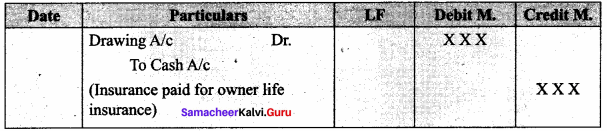
Question 5.
State the principles of double entry system of bookkeeping.
Answer:
Following are the principles of double entry system:
- Every business transaction has two aspects.
- The two aspects involved are receiving aspect and giving aspect.
- These two aspects involve minimum two accounts; at least one debit and one credit.
- For every debit, there is a corresponding and equivalent credit.
Question 6.
Briefly explain about steps in journalising.
Answer:
- Analyse the transactions and identify the accounts.
- Classify the above accounts under Personal account, Real account or Nominal account
- Apply the rules of debit and credit for the above two accounts.
- Find which account is to be debited and which account is to be credited.
- Record the date of transaction in the date column.
- Enter the name of the account to be debited in the particulars column followed by the abbreviation ‘Dr.’ at the end in the same line. Against this, the amount to be debited is entered in the debit amount column in the same line.
- Write the name of the account to be credited in the second line starting with the word ‘To’ prefixed a few spaces away from the margin in the particulars column. Against this, the amount to be credited is entered in the credit amount column in the same line.
- Write the narration within brackets in the next line in the particulars column.
Question 7.
What is double entry system? State its advantages.
Answer:
According to this system, every transaction has a two fold effect. That is, there are two aspects involved, namely, receiving aspect and giving aspect. It is denoted by debit (Dr.) and credit (Cr.).
Comments
Post a Comment